


Every year, machinery-related incidents result in hundreds of deaths and tens of thousands of amputations across manufacturing sectors. The reality is stark: dangerous machinery doesn’t care about experience levels or how many times a task has been performed safely before. What stands between workers and serious injury often comes down to one critical element—properly selected and maintained machine guards. Machine guards protect workers by preventing injuries from hazardous machine parts, such as crushed hands, burns, blindness, or amputations.
This article breaks down the four main types of machine guards, explores specific applications in machine shops and automated assembly lines, and provides practical guidance on selection, maintenance, and compliance. Whether you’re evaluating existing equipment or planning new installations, understanding these guarding methods is essential for protecting your workforce.
Key Takeaways- The four primary machine guard types are fixed, interlocked, adjustable, and self adjusting guards, each suited to different hazards, access frequencies, and operational needs. - Effective guarding is required by OSHA 1910.212 in the United States and forms the foundation of any machine safety program focused on worker safety. - Guard choice must emerge from a formal risk assessment that considers access needs, maintenance requirements, and the machine’s lifecycle. - Guards can be integrated at the point of operation, around power transmission components, or as perimeter systems around entire robotic work cells. - Our team can help design, supply, and validate guarding—including performing documented risk assessments through MPSA. |
Machine guards are physical barriers designed to protect workers from mechanical hazards such as rotating parts, in-running nip points, flying debris, and crushing motions. Different types of machine guards exist because hazards vary widely—from point-of-operation dangers on a lathe to ejection risks in automated manufacturing cells.
These guards appear across industrial environments: metalworking shops with lathes and mills, packaging lines, conveyor systems, and robotic work cells. OSHA requirements under 1910.212 mandate effective guarding, while standards like ANSI B11 and ISO 12100 provide frameworks for risk reduction. Selecting appropriate guarding methods is central to meeting these specific requirements.
This article covers the main categories of guards used in modern occupational safety programs, followed by machine-specific applications, selection guidance, and maintenance practices.
Skip to a Section
Four Types of Machine Guarding | Machine Guard Types Comparison | Machine Shop Safety Guards | Physical Guarding in Automated Manufacturing | Choosing the Right Type of Machine Guard | Maintenance, Inspection, and Compliance | How We Support Machine Guarding and Safety | Additional resources | Frequently Asked Questions
Four Main Types of Machine Guarding
Four types of guards dominate most standards and guidance documents: fixed, interlocked, adjustable, and self adjusting guards. In practice, many installations combine multiple types—perimeter fencing with interlocked doors and fixed covers over drives, for example. Machine guards can also be tailored or constructed to suit many specific applications in different industrial settings.
A risk assessment determines which type or combination provides maximum protection based on access frequency, injury severity, and defeat possibilities.
Fixed Guards
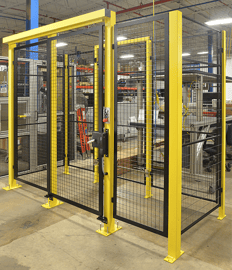
Fixed guards are permanently attached barriers that protect a person from hazardous machine parts, requiring tools for removal. They have no moving parts or sensing elements.
Common forms include:
- Sheet metal or polycarbonate covers over belts and pulleys
- Guards over flywheels and couplings
- Tunnel guards on conveyor in-feeds
- Perimeter fencing panels around robots
Advantages include that fixed guards provide maximum protection, usually require minimal maintenance, are highly reliable, difficult to bypass, and offer continuous protection. This makes them suitable for high production, repetitive operations. Limitations involve reduced accessibility for frequent tasks and the need for secure anchoring to withstand impact and vibration. Standards require guards have specific distances from hazards
Interlocked Guards
Interlocked guards connect physical barriers to the machine’s control system. Opening the guard stops hazardous motion or prevents accidental startup. When an interlocked guard is opened while the machine is operating, a stop command is triggered that disengages the power source, preventing the machine from restarting until the guard is closed again.
Examples include:
- Swing doors on robotic cells with safety interlock switches
- Sliding access panels on packaging machines
- Lathe shields that halt spindle rotation when opened
These guards excel where frequent access is needed for setup, loading, or clearing jams. Interlocked guards are particularly beneficial for machines that require frequent maintenance, as they allow for easy removal and replacement without shutting down the entire machine. Interlocks can be mechanical, electromechanical, or non-contact, configured to meet required safety performance levels. OSHA cites interlock bypasses in 20-30% of guarding violations—a clear sign of design or training problems.
Adjustable Guards
Adjustable guards allow manual repositioning to accommodate varying sizes of workpieces or tooling. They provide flexibility in job shops with diverse part sizes. Adjustable guards provide a barrier that can be adjusted for many different operations, including various jobs, tooling setups, and sizes of stock.
Examples include:
- Movable shields on drill presses
- Sliding polycarbonate panels on manual milling machines
- Blade guards on band saws with frequent adjustment capability
While offering lower cost and flexibility, adjustable guards depend heavily on operator behavior. Adjustable guards may not offer the same level of protection as fixed or interlocked guards and may require frequent maintenance. Incorporate positive stops, scales, and clear markings to encourage correct positioning.
Self Adjusting Guards
Self adjusting guards automatically move in response to material feed, maintaining minimal gaps while allowing work to pass. The guard returns to its protective position after the material clears.
Examples include:
- Spring-loaded blade guards on circular saws
- Automatically positioning guards on high-volume cutting equipment
Benefits include consistent protection across shifts without manual intervention. However, springs and linkages require inspection every 3-6 months, and these guards often supplement other means of protection as part of a layered strategy.
Machine Guard Types Comparison Table
|
Guard Type |
Description |
Pros |
Cons |
Best Uses |
|
Fixed Guards |
Permanently mounted physical barriers that require tools for removal |
- Highest level of protection - Very reliable (no moving parts) - Low maintenance - Difficult to bypass |
- Limits access for maintenance or setup - Requires shutdown and tools for removal - Not ideal for frequent interaction |
- Power transmission components (belts, pulleys, gears) - Conveyor in-feeds (tunnel guards) - Robotic cell perimeter fencing - High-production environments |
|
Interlocked Guards |
Guards connected to the control system that stop or prevent machine operation when opened |
- Allows safe access without full system exposure - Ideal for frequent access points - Can be integrated with safety systems |
- More complex and costly - Requires proper design and validation - Can be bypassed if poorly implemented |
- Robotic cell access doors - Packaging machines - CNC enclosures - Areas requiring frequent setup or clearing jams |
|
Adjustable Guards |
Manually repositioned guards that adapt to different part sizes or operations |
- Flexible for varying workpieces - Lower cost than automated options - Useful in job shops |
- Relies on operator behavior - Less consistent protection - Requires frequent adjustment and oversight |
- Drill presses - Manual mills - Band saws -Environments with frequent changeovers |
|
Self-Adjusting Guards |
Guards that automatically move with the material while maintaining minimal exposure |
- Maintains protection during operation - No manual adjustment needed - Improves consistency across shifts |
- Moving parts require maintenance - Limited to specific applications - Often used with other safeguards |
- Circular saws - Cutting equipment - High-volume material feed |
Machine Shop Safety Guards
Beyond the four main types, guards are often described by the machine they protect employees on. These applications use the same underlying principles, with point-of-operation guarding being a key aspect of machine shop safety by ensuring hazardous areas at the point of operation are properly shielded.
Chuck Guards for Lathes
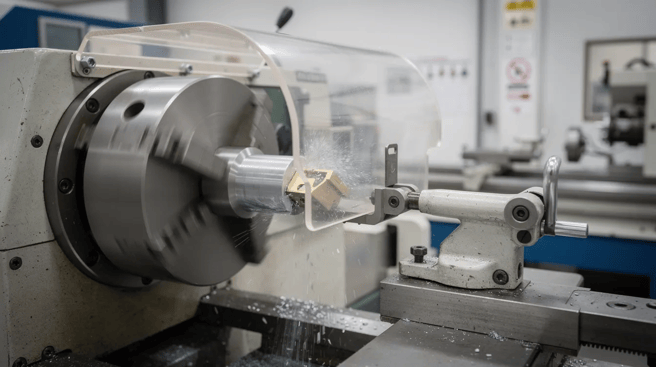
Chuck guards are curved or hinged shields covering the rotating chuck and part on engine and CNC lathes, typically featuring transparent viewing panels. They protect against entanglement, impact from thrown workpieces, and flying chips.
Features often include swing-away motion for tool changes and optional interlocks. A risk assessment should consider chuck speed, part size, and operator positioning.
Drill Press Guards
Drill press guards cover the rotating spindle, chuck, and drill area to prevent contact and contain chips. Forms include wrap-around polycarbonate shields and telescoping tube guards.
Main goals: prevent hands from entering the danger zone, reduce exposure to flying debris, and encourage proper workpiece clamping over hand-holding—a factor in 15% of shop injuries.
Lathe Guards Beyond the Chuck Area
Lathe guarding extends beyond the chuck to include covers for lead screws, feed shafts, drive belts, and protruding stock. Examples include fixed covers over belt drives, telescoping leadscrew covers, and long-stock supports preventing material whipping.
A complete solution often combines fixed guards, interlocked chuck covers, and adjustable shields around the cutting zone.
Milling Machine Guards
Milling machine guards protect against rotating cutters on vertical and horizontal mills. Forms include front-opening sliding shields, fixed covers over belt drives, and interlocked doors on CNC enclosures.
Any modifications to enclosures—cutting openings or propping doors—require risk assessment review to restore safety performance.

Physical Guarding in Automated Manufacturing
Automated manufacturing presents unique challenges requiring comprehensive guarding strategies that address multiple machines and process zones.
Perimeter Safety Barriers and Fencing
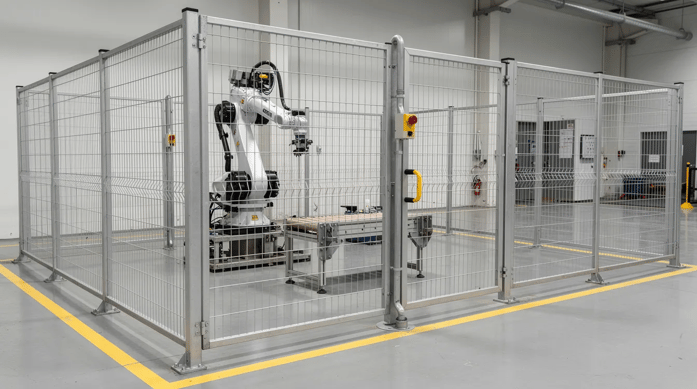
Perimeter guarding surrounds entire cells to separate personnel from hazardous motion. Components include wire mesh panels, posts, anchoring hardware, and interlocked gates for access by maintenance personnel. Wire machine guards and safety barriers help prevent workplace accidents by creating physical protective zones and controlling hazardous zones.
Design considerations include safe distances based on stopping time, prevention of climb-over and reach-through, and clear marking of emergency exits.
Adjustable and Modular Hard Guards
Adjustable barriers can be repositioned for different part sizes or tooling setups. Modular framing-based systems allow easy expansion or reconfiguration as layouts change—essential in flexible automation environments.
Enclosure Guards (Full Machine Enclosures)
Full enclosures surround equipment on all sides, including tops when needed. Used in high-risk custom applications like robotic welding or machining, they contain sparks, debris, coolant, and ejected parts.
Conveyor Guarding
Conveyor guarding includes:
- Side guards preventing inadvertent access to pinch points
- Protective covers over drive components like rollers, chains, and sprockets
- Tunnel guards fully enclosing sections where access is unnecessary
Anti-Reach and Anti-Climb Features
Effective perimeter barriers incorporate:
- Smaller mesh openings (maximum one half inch) to prevent reach-through
- Angled tops or extensions preventing climb-over
- Proper guard height based on risk level
Containment Guarding
Containment guards specifically address flying debris and ejected material. Made from impact-resistant polycarbonate, they’re common in machining, cutting, and automated handling where potential hazards include high-velocity parts.
Robot Base and Axis Guarding
Physical barriers around robot bases prevent access to pinch points and sweep zones behind or beside the equipment. Often overlooked, this guarding addresses hazards beyond obvious entry points.
Cable and Hose Protection Guards
Routing guards protecting exposed cables, air lines, and hydraulic hoses prevent entanglement, snagging, and accidental damage while reducing trip hazards around automated cells.
Automated Cell Partitioning
Internal barriers within larger fenced areas separate processes—isolating a robot from a conveyor, for example. This limits risk during maintenance or partial system access.
Palletizer and Depalletizer Guarding
Dedicated layouts for palletizing systems include wraparound barriers and restricted drop zones protecting against falling loads and robot movement. Reinforced panels address high-impact zones.
Restricted Access Panels
Small, fixed panels requiring tools for removal provide controlled maintenance access to specific components where frequent access isn’t needed—reinforcing deliberate entry only.
Impact-Resistant Guarding Zones
Reinforced sections with thicker panels, double-layer mesh, or polycarbonate inserts address areas with higher collision or ejection risk, common near robotic pick points.

Selecting the Right Type of Machine Guard
Guard selection follows technical standards and formal risk assessment—not cost or preference alone. Key factors include:
|
Factor |
Consideration |
|
Hazard type |
Cutting, crushing, entanglement, ejection |
|
Access frequency |
Rare favors fixed; frequent favors interlocked |
|
Automation level |
Higher automation often requires perimeter systems |
|
Workpiece variation |
Various sizes may need adjustable guards |
Well-designed guarding makes the safe approach the easy approach, reducing temptation to bypass protection. Our team supports evaluation of existing machinery and recommends appropriate solutions.
Maintenance, Inspection, and Compliance
Even well-designed guards become ineffective without regular inspection. Routine checks should include:
- Damage to panels or missing fasteners
- Gaps from misalignment or impact
- Wear on hinges and latches
- Contamination reducing visibility
Test interlocks periodically to confirm opening a guard reliably stops hazardous motion. Document all inspections and corrective actions to demonstrate ongoing OSHA compliance. Include guarding checks in daily operator walk-arounds and preventive maintenance schedules.
How We Support Machine Guarding and Safety
We specialize in helping facilities identify hazards, specify appropriate guard types, and integrate them with control systems. Our offering includes safety components such as fixed barriers, interlock hardware, and accessories supporting compliant installations.
Beyond products, we provide engineering support: layout reviews, guard design guidance, and coordination with maintenance and operations teams.
Ready to improve your machine safety? Contact us to discuss your specific needs, request a quote for guarding components, or schedule an on-site evaluation. Remember: a documented risk assessment is the critical first step—and MPSA provides this service, translating findings into practical guarding solutions for your heavy equipment and processes.

Additional Resources
FAQ: Control Cabinet Air Conditioners
Do older machines need the same types of guards as new equipment?
Older machines often lack built-in guarding and may present higher risks. OSHA focuses on hazard presence rather than equipment age—if hazardous motion exists, it must be guarded regardless of installation date. Start with a risk assessment on legacy equipment to identify critical hazards and feasible options without excessively disrupting production.
How often should machine guards and interlocks be inspected?
Combine daily visual checks by operators with formal monthly or quarterly inspections by maintenance personnel or safety staff. Schedule interlock function tests based on the machine’s risk level and duty cycle, documenting all results. Any incident, near miss, or modification should trigger immediate inspection.
Can presence-sensing devices replace physical guards?
Light curtains, laser scanners, and pressure-sensitive mats are valid safeguarding measures but aren’t always direct replacements for physical barriers. Standards treat these as complementary options chosen through risk assessment. Involve machine safety specialists to ensure correct placement, integration, and validation.
What training do employees need regarding machine guards?
Operators, maintenance personnel, and supervisors should understand each guard’s purpose, operation, and why defeating or removing guards is prohibited. Include guard-related topics in lockout/tagout training, job-specific instructions, and refresher courses—using site-specific examples rather than generic material.
How does a risk assessment influence guard selection and design?
A risk assessment systematically evaluates harm severity, likelihood, exposure frequency, and avoidance possibilities, then recommends risk reduction measures. The outcome specifies appropriate guard types, locations, and required performance levels. MPSA conducts these assessments and helps translate findings into practical guarding solutions tailored to your specific applications.